




#a6 :: Carrier pigeon message capsule (part 1)
February 19, 2008
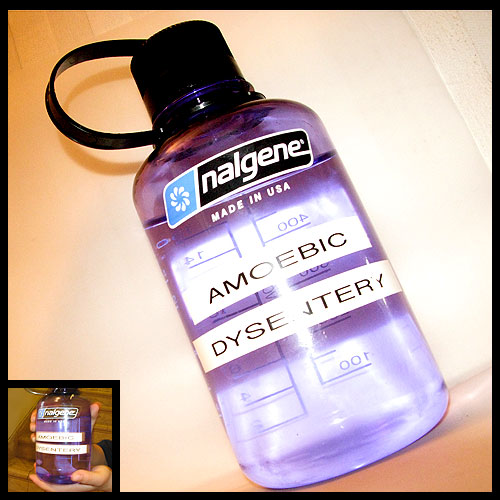 For the past, order let’s see, six months, my 8-year-old son has been bandying this … phrase … about.
For a while, he didn’t know what it meant, and cared even less, but he would utter this phrase every chance he got, snickering and cackling like a fiend.
It is the funniest thing he’s ever heard. And for the first two or three times I heard him say it and cackle, it was the funniest thing I’d heard in a couple of hours, at least.
Now, hold that thought.
Saturday was packed with errands. My daughter and I hustled through Big 5 Sporting Goods in Glendale and picked up a couple of 500ml Nalgene water bottles.
She and her brother don’t do the whole school-milk thing, and they needed something more reliable to cram into their lunch boxes than the usual blowmolded PVC bike bottles that float through the house. So, at $5.99 each, this seemed like a pretty good deal.
Rather than give him a color choice later and spark a fight, I bought two in amethyst. Upon returning this afternoon from a short trip to San Diego, we began getting ready for school tomorrow.
Hmm. Now, how to tell the water bottles apart?
My wife let our daughter use the label maker. She’s 6. She bangs out “I HATE HITLER.” No, I don’t know where the hell it came from either.*
I vetoed it, only briefly considering the irony of my censorship. (Am I a bad dad?)
Before I knew it, my son had snatched the labeler. He came into my office 10 minutes with something behind his back. Snickering. Chortling.
“Dad, what’s that thing I’m aaaalways saying? That word?”
I shrug. “I don’t know, what?”
“I’m aaaaalways saying it … A – M – O – E …” he can barely contain his mirth.
I draw a blank (too much time on the road from SD).
“Daaaad …” And he whips it out – a just-filled Nalgene bottle with condensation trickling down its purple plastic flanks and a huge-lettered label plastered carefully across it – and bursts out laughing.
I burst out laughing too. Not just smirking, internet-ROTFLMAOPIMP, but real-life jaw-cracking throw my head back and slap my knee guffaws. Funniest goddamn thing I’ve seen in weeks, in big 72-point type:
AMOEBIC
DYSENTERY
Click the thumbnail to view a larger version (as you can with any image on HLO).
It looked like a prop from some straight-to-video cyber-thriller – dripping with psychedelic menace. Aha, so that’s what a flask of concentrated amoebic dysentery looks like.
For the record, my wife and daughter laughed their asses off, too.
Then again, maybe it’s only funny because he’s our kid.
*Well, okay, I do have an idea where – Patton Oswalt and a couple of other comics were doing this bit with a voice like the Boss from any 50s sitcom, the key line of which, delivered in a gravelly and irritated basso profundo, went:
For several weeks after I recounted that to them in the car (you see where this comes from) they’re both repeating it with me every few days. And we’re all cackling like idiots.
 Featherlight. Tiny. Packed tight like a bomb.
Barely half an inch long and weighing but a few grams, price this stamped-aluminum capsule came (from an Escondido antique store) fully loaded. A rolled-up pellet of tissue taunts me with veiled possibility.
What’s it say? So many possible roads it could take:
Vital vintage intel? A message intercepted? A cheerful howdy between pigeon enthusiasts? A kill order from central HQ?
More on carrier pigeons here:
The U.S. Army used specially trained homing pigeons to carry messages during WWI and WWII. They were considered an undetectable method of communication. Fort Monmouth, more about New Jersey was the home of the U.S. Army Pigeon Breeding and Training Center from 1917 until 1957. A small capsule would be placed around the leg of the pigeon and a paper message was put into the capsule. The bird would be released to fly to its home loft with the message. Pigeons have been known to fly hundreds of miles in a day with a mile a minute being the average speed. Military historians claim that over 90% of all messages sent by the US Army using pigeons were received. Pigeons were also used to carry maps, photographs and cameras. The birds are credited with saving thousands of lives. The U.S. Army discontinued using pigeons as message carriers in 1957 due to more modern and faster transmission methods.
I can picture the pigeon in the handler’s hands: He gathers the bird from its coop, gently grasping its wingtips and tail feathers in one hand, the fresh message capsule in the other.
Carefully, he crimps the metal tabs together around the bird’s sticklike leg. He blows on the pigeon for luck, tosses it softly into the air. Watches it flapflap its way out of sight, its wingtips slapping each other as it flees his grasp.
I won’t fully open it until tomorrow. Patience. Let the power of this build.
Filed under: Artifact, symbol, Tool | Comments (0)